Considering the lack of a universal, or even a clear definition of "art" in any culture makes it likely that there has to be an endless variety of different or competing conceptions of it. Although it is in our culture as American's to determine individualism, and therefore would make sense for American's to insist these differences, there is a universal trend as to what tends to be aesthetically pleasing, and what is not. But this is not a constant truth. Different cultures will conceptualize art differently based on differences in lifestyles, values, access to materials, and historic context. These differences create some distinctions as to what is and is not art based on cultural perception.
For example, what one culture creates as necessity, may be seen by another as having artistic intent. An example would be Egyptian hieroglyphics which to foreigners often look like intricate designs and symbols up for aesthetic contemplation where as ancient Egyptians may have looked at them as commonly as you read this sentence. At the same time, our perception of a urinal in an exhibition being art because it is "out of context" may seem obscure to someone from a third world country who has never seen indoor plumbing and therefore cannot see the difference between the Fountain exhibit and the actual restroom down the hall.
In this way, perceptions of art are dependent upon underlying factors both culturally and individually. There seems to be a basic cross-cultural understanding which humans share which allows us to generally recognize art, however it is not constant. Differences in culture can play a large role in this recognition.
Question:
Does the lack of a universal definition of art allow for art to be subjective? In other words, can something be art to me, but not to someone else?
Saturday, December 12, 2009

Tuesday, December 8, 2009
Response to Tania
What do adults gain from art?

This is an interesting case in art for two reasons. First, there was a huge backlash when word of this art project was released and thousands of people who heard about the story through primarily internet sources, they began flooding facebook groups and blogs with petitions to stop the exhibition. Like we see in this case, people do not see all art as being worth the symbolism which the artist is trying to express. Second, after the initial buzz of this exhibition, skeptics began to search for the story's origins and were not able to find a clear source. It is still debated as to whether or not the exhibition ever actually took place. This shows the ease at which people can sometimes be swayed by art just as easily as mass media.
With this being said, I would say that the creation of art would likely have positive effects on the artist (creator/performer/etc) for it's creative outlet qualities. As far as the effect art has on the experiencer, I would have to say that getting a glimpse of another's point of view, no matter how you interpret it, will more often than not benefit you rather than have adverse effects.
Question:
What do you think about the influence that mass media has on some art (such as 'mainstream' genres)?
As such a general question I could easily say that depending on their perspective, people could gain everything as much as nothing from art, but I feel like that is a cop-out. I should first note that the best definition I can come up with to describe art in a general sense (not specific to any one form) would be that it is the result of a humans attempt to document expression or emotion. If this is true then I think that adults use art just as children, as an outlet. I wouldn't however go as far to describe art as being necessarily an outlet which is socially acceptable. Although this is true in many cases where various art forms are widely praised and generally any artistic initiative is seen as positive but there are many pieces of art which are said to be obscene or morally wrong such as back in October 2007 Costa Rican artist Guillermo Habacuc Vargas supposedly captured a stray dog and chained it in a gallery without food and water with a sign on the back wall made of dog biscuits stating “Eres Lo Que Lees” (”You Are What You Read”).

This is an interesting case in art for two reasons. First, there was a huge backlash when word of this art project was released and thousands of people who heard about the story through primarily internet sources, they began flooding facebook groups and blogs with petitions to stop the exhibition. Like we see in this case, people do not see all art as being worth the symbolism which the artist is trying to express. Second, after the initial buzz of this exhibition, skeptics began to search for the story's origins and were not able to find a clear source. It is still debated as to whether or not the exhibition ever actually took place. This shows the ease at which people can sometimes be swayed by art just as easily as mass media.
With this being said, I would say that the creation of art would likely have positive effects on the artist (creator/performer/etc) for it's creative outlet qualities. As far as the effect art has on the experiencer, I would have to say that getting a glimpse of another's point of view, no matter how you interpret it, will more often than not benefit you rather than have adverse effects.
Question:
What do you think about the influence that mass media has on some art (such as 'mainstream' genres)?
Saturday, December 5, 2009
What factor do you think differentiates "pornography" and "erotica?"
I think that the main difference between pornography and erotica is that generally, pornography has the primary purpose of causing sexual arousal where erotica tends to primarily function first as art or literature which falls into a genre of sexual themes or qualities. Although there could be pornography out there that has artistic qualities, pornography speaks to the primary intent of the piece to cause the audience to become sexually aroused. Erotica may also cause the audience to become sexually aroused but I think this correlates more to the fact that erotica contains sexual themes and qualities.
I equate it with someone taking photographs to document a party in comparison to someone who considers themselves a photographer. Where pornography has the clear intent of documenting a moment for the sake of sexual arousal, erotica focuses more on motive, scene-setting, and developing a mood to evoke sexual contemplation which sometimes comes with arousal.
I don't think that there can be a clear distinction between erotica and pornography because it is dependent on what the audience is getting out of the content. What is pornography to one person could be considered erotica to another and vice versa.
Question:
With this being said about erotica and pornography, do you think the lack of motive in pornography is grounds to consider it not as art?
I think that the main difference between pornography and erotica is that generally, pornography has the primary purpose of causing sexual arousal where erotica tends to primarily function first as art or literature which falls into a genre of sexual themes or qualities. Although there could be pornography out there that has artistic qualities, pornography speaks to the primary intent of the piece to cause the audience to become sexually aroused. Erotica may also cause the audience to become sexually aroused but I think this correlates more to the fact that erotica contains sexual themes and qualities.
I equate it with someone taking photographs to document a party in comparison to someone who considers themselves a photographer. Where pornography has the clear intent of documenting a moment for the sake of sexual arousal, erotica focuses more on motive, scene-setting, and developing a mood to evoke sexual contemplation which sometimes comes with arousal.
I don't think that there can be a clear distinction between erotica and pornography because it is dependent on what the audience is getting out of the content. What is pornography to one person could be considered erotica to another and vice versa.
Question:
With this being said about erotica and pornography, do you think the lack of motive in pornography is grounds to consider it not as art?
Tuesday, December 1, 2009
Response to Betsy's question on morality
Do you think most people's decisions are based in their morality?
I would have to say yes, I do think that most people make decisions based on their personal morality. What I can't say, is how exactly this morality is formed on a person to person basis. Possibly there could be a mixture of biology and environmental factors. This question also reminds me of the chicken and the egg dilemma. There has been much dispute whether or not violent (or immoral) pornography causes violence in people. I would think that this is not the case but rather that people who are violent (or socially considered immoral beliefs) are more likely to view violent pornography.
People are tied heavily to their moral beliefs, we can see it in politics. Although politics are designed to make decisions on behalf of the people as a whole, politicians are constantly basing decisions off of their personal morals. People cannot help but base decisions on morality, it is the core of our conscience. Of course not all decisions are based on morality, it is all within context, but I think that through the arts people put their morality to the test consistently to prepare for real-life decision making.
Question:
What do you make of violent role-play pornography and erotica where the participants are not actually being harmed but violent scenarios are depicted through fantasy? Is this harmful to human development?
I would have to say yes, I do think that most people make decisions based on their personal morality. What I can't say, is how exactly this morality is formed on a person to person basis. Possibly there could be a mixture of biology and environmental factors. This question also reminds me of the chicken and the egg dilemma. There has been much dispute whether or not violent (or immoral) pornography causes violence in people. I would think that this is not the case but rather that people who are violent (or socially considered immoral beliefs) are more likely to view violent pornography.
People are tied heavily to their moral beliefs, we can see it in politics. Although politics are designed to make decisions on behalf of the people as a whole, politicians are constantly basing decisions off of their personal morals. People cannot help but base decisions on morality, it is the core of our conscience. Of course not all decisions are based on morality, it is all within context, but I think that through the arts people put their morality to the test consistently to prepare for real-life decision making.
Question:
What do you make of violent role-play pornography and erotica where the participants are not actually being harmed but violent scenarios are depicted through fantasy? Is this harmful to human development?
Sunday, November 22, 2009
real horror show
Carroll suggests that people's fascination with horror does not come from our obsession with tragic events but rather the way in which these events are worked into a plot. I would like to think this is true in some aspects for example, I might go to a Quentin Tarantino film because I enjoy his ability to thrill me with plot twists and his outlandish camera work, despite the fact that his films are extremely violent and often notably filled with gore. Humans enjoy participating in their "mental game" which involves submerging ourselves into fictional situations which force us to consider our own morals and question ourselves. Audiences often find themselves thinking "would I have done that?" or "I would have gotten away differently" in a way similar to how other art forms help us to do the same. Villains in horror represent those things that we hate, find socially unacceptable and often, some form of the "seven deadly sins" which we are told not to overindulge in or we will turn out like these villains. The psychological game of learning about this villain as it impacts our life, struggling with it, finally confronting the villain (i.e. our own conflicts), and finding a way to defeat it is symbolic of our everyday struggles and problem solving conflicts. People can find an outlet for these struggles in horror, it has the attractive element of indulging in these horrific, sometimes animalistic situations which we are deprived of in everyday life.
But what is it about this specific genre that draws people in? What is the psychological explanation for the recent popularity of "slasher" films which lack plot development (excluding the "low-cost" element which explains reality TV shows, etc)?
But what is it about this specific genre that draws people in? What is the psychological explanation for the recent popularity of "slasher" films which lack plot development (excluding the "low-cost" element which explains reality TV shows, etc)?
Friday, November 20, 2009
Response to Ed
Might video games be considered potential works of art?
I would argue that yes, video games can indeed be considered works of art. It seems that although video games may not be an ideal form of art, they follow the criteria which were set in previous chapters which we have read. Video games are interactive art, which allows the gamer (for their benefit or not) to become consumed in a fictional situation where they actually have a level of control over the storyline. When playing a video game, gamers often are completely submerged in the fictional story. Game systems like Wii even allow the gamer to move their body in realistic movements to control games. Unlike film or photography, video games do not require that the themes or characters in the game actually exist. Which for Scruton, this makes a big difference. Video games also take a certain amount of artistic ability to create. The creation of complex games may take an extensive amount of time and requires attention to detail. The artist creating the game represents some sort of intent through their work which may be interpreted by the gamer. My only resistance here is the capacity for a video game to move someone. I have to think that video games do posses this characteristic for the simple fact that when I was younger I was afraid of playing "zombie" themed games and would nearly toss the controller when it got too intense. We could also argue that video games have caused some people to "copycat" in real life, extensive studies show that violence in video games can be translated into violence in life. This statistic is debatable for me. I am not entirely sure if people are more violent as a result of video games, or just if violent people play violent games?
Although I would not necessarily claim that video games are a "major" art form, I feel that the amount of artistic ability involved in creating a game, and the emotions and reasons for playing them correlate to the criteria we have discussed which constitutes a work of art.
With game systems like Wii which force the gamer to actively participate (let's say, bowling for example), when this much physical effort is needed to play a game, what is it that prevents the gamer from going out and actually participating in real-life situations (i.e. actually going bowling)?
I would argue that yes, video games can indeed be considered works of art. It seems that although video games may not be an ideal form of art, they follow the criteria which were set in previous chapters which we have read. Video games are interactive art, which allows the gamer (for their benefit or not) to become consumed in a fictional situation where they actually have a level of control over the storyline. When playing a video game, gamers often are completely submerged in the fictional story. Game systems like Wii even allow the gamer to move their body in realistic movements to control games. Unlike film or photography, video games do not require that the themes or characters in the game actually exist. Which for Scruton, this makes a big difference. Video games also take a certain amount of artistic ability to create. The creation of complex games may take an extensive amount of time and requires attention to detail. The artist creating the game represents some sort of intent through their work which may be interpreted by the gamer. My only resistance here is the capacity for a video game to move someone. I have to think that video games do posses this characteristic for the simple fact that when I was younger I was afraid of playing "zombie" themed games and would nearly toss the controller when it got too intense. We could also argue that video games have caused some people to "copycat" in real life, extensive studies show that violence in video games can be translated into violence in life. This statistic is debatable for me. I am not entirely sure if people are more violent as a result of video games, or just if violent people play violent games?
Although I would not necessarily claim that video games are a "major" art form, I feel that the amount of artistic ability involved in creating a game, and the emotions and reasons for playing them correlate to the criteria we have discussed which constitutes a work of art.
With game systems like Wii which force the gamer to actively participate (let's say, bowling for example), when this much physical effort is needed to play a game, what is it that prevents the gamer from going out and actually participating in real-life situations (i.e. actually going bowling)?
Sunday, November 15, 2009
The previous blog on "suspension of reality" got me thinking about Tania's take on Aristotle's theory discussing the potential effects of exposure to virtual traumatic fiction. As adults we engage in mental games, often through participation in the arts, to cope with the reality of understanding the actual world which is arguably not established during early childhood. Aristotle claims that contemplation of these fictional situations can be healthy in the way that it helps prepare or "cleanse" us for future situations in the real world. My question is about what happens when people start engaging in these fictional situations to the point that we begin seeing life as an imitation of art rather than art as an imitation of life? Turn the TV to any "reality television" show and you will see anything but. What you will see is people then imitating and getting ideas from these shows and using them in actual life which can be harmful. It is important to note that beneficial lessons can also be taken from the arts, but I must highlight that I am speaking to the quantity in which we absorb fictional material not to the material itself. I feel that by consuming large amounts of fiction in the way that (for example) American culture does, we go into a sort of overload where we become neurotic in preparing ourselves for obscure situations to the point where we are forgetting to live in the present. Going back to a blog I posted on Alan Watts, author of The Wisdom of Insecurity he equates this theory to trying to think about reading this sentence as you concentrate on reading it. You will find that you cannot do both at once, if we engage in these metal games to the point that we lose complete awareness of what real life is, it could have negative effects.
What is your take on this?
What is your take on this?
Considering most watch movies of the sort as adults, could is be that we are just maybe missing an element of physical play, which was found in childhood, during the time when one may not have enjoyed these sorts of movies as much?
This is an interesting point. I think it is possible that as we get older, we tend to react more strongly to concepts in films as a sort of "mental game" to put ourselves in fictional situations, which we then become emotionally involved with because of their symbolism to the actual world. I feel that children do not need a temporary "suspension of reality" to engage in play or imaginative games because they haven't yet gained enough real-life experience to have reason to believe that these situations might not actually exist somewhere. For example, a group of children playing pirates on the playground may very well believe that somewhere, real Peter Pan-style pirates could exist. As an adult watching Johnny Depp in Pirates of the Caribbean, we do not have to believe that these events are actually going on in the world to enjoy them. A child viewing Walton's slime on the movie screen may actually be afraid of the slime, and could even be moved to action (for a child that would be crying, seeking help from the adults), where as adults have lost that naivity of the actual world and therefore enguage in these mind games which requires suspending your awareness of the real world.
Watching a commercial on television a while back, I was confused when I saw an ad campaign for some prescription drug which opened with an actor from the show "E.R." in his surgeons outfit saying, "I'm not a doctor, but I play one on TV..." As adults, why is it that this actor who plays a doctor on television, has an opinion on a drug that would be just as justified as an actual doctor? I found an article later that made me rethink my question. The actor, James Franco was speaking of his experiences with films and specifically Pineapple Express. Franco talks about the work he did to prepare for these films including spending months living on the street to prepare for role of a junkie, and gymnastics for Spiderman. Hillary Swank lived as a man (binding, packing, and cutting her hair) for a full month to prepare for the role of Brandon Teena in Boys Don't Cry. A part of me feels that the line between our fictional situations and our perception of the actual world continues to merge as we go. My question is where is the fiction in the story if the actors in it had to live those events in actual life just to prepare for the role, generally speaking of course?
This is an interesting point. I think it is possible that as we get older, we tend to react more strongly to concepts in films as a sort of "mental game" to put ourselves in fictional situations, which we then become emotionally involved with because of their symbolism to the actual world. I feel that children do not need a temporary "suspension of reality" to engage in play or imaginative games because they haven't yet gained enough real-life experience to have reason to believe that these situations might not actually exist somewhere. For example, a group of children playing pirates on the playground may very well believe that somewhere, real Peter Pan-style pirates could exist. As an adult watching Johnny Depp in Pirates of the Caribbean, we do not have to believe that these events are actually going on in the world to enjoy them. A child viewing Walton's slime on the movie screen may actually be afraid of the slime, and could even be moved to action (for a child that would be crying, seeking help from the adults), where as adults have lost that naivity of the actual world and therefore enguage in these mind games which requires suspending your awareness of the real world.
Watching a commercial on television a while back, I was confused when I saw an ad campaign for some prescription drug which opened with an actor from the show "E.R." in his surgeons outfit saying, "I'm not a doctor, but I play one on TV..." As adults, why is it that this actor who plays a doctor on television, has an opinion on a drug that would be just as justified as an actual doctor? I found an article later that made me rethink my question. The actor, James Franco was speaking of his experiences with films and specifically Pineapple Express. Franco talks about the work he did to prepare for these films including spending months living on the street to prepare for role of a junkie, and gymnastics for Spiderman. Hillary Swank lived as a man (binding, packing, and cutting her hair) for a full month to prepare for the role of Brandon Teena in Boys Don't Cry. A part of me feels that the line between our fictional situations and our perception of the actual world continues to merge as we go. My question is where is the fiction in the story if the actors in it had to live those events in actual life just to prepare for the role, generally speaking of course?
Sunday, November 8, 2009
Observations of Photography
While attending a wedding two weeks back, I noticed lots of people taking pictures throughout the ceremony. I have often criticized this tendancy of people to choose "seeing through the camera" almost as if it is better than seeing in real life. Another example can be found at any concert. Look around at people who are watching large chunks of the show through their camera lense. I feel that in these situations, people become so focused on preserving memories from events that they forget to actually watch them. I find myself at shows telling friends to put their camera's down and actually watch the show, otherwise what are you preserving if you have no memory of ever watching the show with your own eyes?
Back to this wedding that I was at. Whenever the parents didn't get a 'good' photo of the brides during the ceremony, they would shout "wait, pose like you are doing that again! I missed the shot!" I kept thinking to myself, if the essence of photography as Scruton would say, is to preserve a copy of a moment, yet you intentionally stage the moment to get a photo of it. What exactly are you getting a photo of? Will these people remember that this was not their first kiss, it had actually taken place a few moments before and was then recreated for a photograph to be taken? I am confused by this common tendancy. I'm sure we have all done it at one point or another...
Question:
does anyone have an opinion as to why?
Back to this wedding that I was at. Whenever the parents didn't get a 'good' photo of the brides during the ceremony, they would shout "wait, pose like you are doing that again! I missed the shot!" I kept thinking to myself, if the essence of photography as Scruton would say, is to preserve a copy of a moment, yet you intentionally stage the moment to get a photo of it. What exactly are you getting a photo of? Will these people remember that this was not their first kiss, it had actually taken place a few moments before and was then recreated for a photograph to be taken? I am confused by this common tendancy. I'm sure we have all done it at one point or another...
Question:
does anyone have an opinion as to why?
Question: What about 'representation' means that it must be something other than a mere moment?
I don’t think that Scruton is claiming that a mere moment isn’t capable of representation. Rather he is implying that with photography, one is limited to photographing the existing world as is, and therefore leaves no room for artistic intent unless the photographer “becomes a painter of sorts”. His argument supports the fact that a photograph is simply a captured moment in time and although that moment may have represented the general feel of the times, or the like, it is not the photograph itself that is representational, it is the moment. The photograph has just captured a moment and provided the photographer with a hard-copy of that moment.
I would argue that Scruton’s ideals for what the essence of photography is, is skewed. His definition seems to only capture the very basics of what photography is capable of. There must be some artistic merit in the ability of a “good photographer” to choose their targets carefully and with the right timing to capture the intent that they are going for. Even in staged photographs, there are techniques used with lighting, shutter speed, exposure time, and a variety of other methods, many being specific to the art of photography and cannot be attributed to painting or other art forms. I would argue that one could find representation in the art of photography itself. Photographers often put themselves in the way of danger to capture photographs, with this the idea of having a hard-copy of a moment in time which would be otherwise inaccessible to most people, there is room for actual emotional responses since the depictions in the photograph are known to actually exist. In the next section we discuss the problem of evoked emotional responses from fictional characters. When viewing a painting, there needs to be some level of suspended awareness of reality in order to evoke a true emotional response. With a photograph, we are able to allow actual emotional responses because the photographed moment is known to actually have taken place at one time.
Question:
What would Scruton say about film as a visual art?
Scruton’s idea of ‘representation’ focuses strongly on the existance of the photographed object in comparison to the created objects depicted in painting (the example that he uses). He makes the point that when viewing a painting, there are three points of representation. One being the intentional object of sight, which is the representation that the viewer is meant to see symbolized by the painting. The represented object is loosely based on the painters intention, the mode in which the painter used to portray their symbolism. And then there is the material object of sight, which would constitute as the painting as a whole. Scruton claims that when we view a painting, we can then make an inference as to what is being represented and what the intentions are.
This photograph, "Dali Atomicus" is Philippe Halsman’s (photographer) reference both to the new atomic age (physicists had recently announced that all matter hangs in a constant state of suspension) and to Dalí’s surrealist masterpiece “Leda Atomica” (which hangs on the right, behind the cats, and unfinished at the time). In 1941 Halsman met the surrealist Salvador Dalí and they began to collaborate in the late 1940s.
I would argue that Scruton’s ideals for what the essence of photography is, is skewed. His definition seems to only capture the very basics of what photography is capable of. There must be some artistic merit in the ability of a “good photographer” to choose their targets carefully and with the right timing to capture the intent that they are going for. Even in staged photographs, there are techniques used with lighting, shutter speed, exposure time, and a variety of other methods, many being specific to the art of photography and cannot be attributed to painting or other art forms. I would argue that one could find representation in the art of photography itself. Photographers often put themselves in the way of danger to capture photographs, with this the idea of having a hard-copy of a moment in time which would be otherwise inaccessible to most people, there is room for actual emotional responses since the depictions in the photograph are known to actually exist. In the next section we discuss the problem of evoked emotional responses from fictional characters. When viewing a painting, there needs to be some level of suspended awareness of reality in order to evoke a true emotional response. With a photograph, we are able to allow actual emotional responses because the photographed moment is known to actually have taken place at one time.
Question:
What would Scruton say about film as a visual art?
Saturday, October 24, 2009
Self Consciousness day to day...
In Dr. Yake's second paper he talks about our self-consciousness in relation to how we reflect on our experiences in measures of time:
"when I look at my behavior of a minute ago and reflect on it, its meaning, its significance, its apparent effects, my intention or non-intention, its causes, its antecedents, etc...I can set limits to my reflection in one way or another, but there are a myriad of angles...that are possible, that are accessible to me..."
This passage reminds me of one from a book by Alan Watts titled, The Wisdom of Insecurity. The books main point is that the only way to truly become secure in oneself, is to abandon the fear of insecurity. He says this with the notion that as long as someone is aware of their sense of security, they will always have reservations and second thoughts and therefore cannot achieve security. Watts gives an example of what he means; Try reading this sentence while reflecting on it at the same time. You will find that it is impossible to do both at the same time. Although we need this occasional reflection, I have found that even Watts forgets his own advice from time to time because he is so caught up in the research and constant thinking about his theory.
Yet he is very convincing in perpetuating his theory through examples; If my happiness at this moment consists largely in reviewing happy memories and expectations, I am but dimly aware of this present. I shall still be dimly aware of the present when the good things that I have been expecting come to pass.
Here, Watts gives a controversial look at reflections. He asserts that always focusing on reflections and predictions about the future keeps us from living in the present times and recognizing the reality of the present. Because of this, Watts argues that the future is essentially meaningless unless it is realized when it becomes present.
Question:
Dr. Yake states that "visual art intervenes in our psychic days and modifies or becomes the grist of our conscious mills, thereby allowing us...into reflections on the various facets of the psychic moment"
Pairing this with Watts' stand on our reflections of daily life, where does visual art come in? Does is distract us from reality or does it aid us to make brief yet frequent reviews or perhaps something completely different?
"when I look at my behavior of a minute ago and reflect on it, its meaning, its significance, its apparent effects, my intention or non-intention, its causes, its antecedents, etc...I can set limits to my reflection in one way or another, but there are a myriad of angles...that are possible, that are accessible to me..."
This passage reminds me of one from a book by Alan Watts titled, The Wisdom of Insecurity. The books main point is that the only way to truly become secure in oneself, is to abandon the fear of insecurity. He says this with the notion that as long as someone is aware of their
 sense of security, they will always have reservations and second thoughts and therefore cannot achieve security. Watts gives an example of what he means; Try reading this sentence while reflecting on it at the same time. You will find that it is impossible to do both at the same time. Although we need this occasional reflection, I have found that even Watts forgets his own advice from time to time because he is so caught up in the research and constant thinking about his theory.
Yet he is very convincing in perpetuating his theory through examples; If my happiness at this moment consists largely in reviewing happy memories and expectations, I am but dimly aware of this present. I shall still be dimly aware of the present when the good things that I have been expecting come to pass.
Here, Watts gives a controversial look at reflections. He asserts that always focusing on reflections and predictions about the future keeps us from living in the present times and recognizing the reality of the present. Because of this, Watts argues that the future is essentially meaningless unless it is realized when it becomes present.
Question:
Dr. Yake states that "visual art intervenes in our psychic days and modifies or becomes the grist of our conscious mills, thereby allowing us...into reflections on the various facets of the psychic moment"
Pairing this with Watts' stand on our reflections of daily life, where does visual art come in? Does is distract us from reality or does it aid us to make brief yet frequent reviews or perhaps something completely different?
Friday, October 23, 2009
Immoral Art
Dr. Stan Yake presented two essays to the class and posed the question: Can we have immoral art; and how might we characterize it?
When viewing art, I often do not think of the actual work as possessing moral characteristics. Without sounding too literal, I feel that art objects or most inanimate objects for that matter do not possess moral qualities and I would actually describe them as being a-moral if anything. It is the ideas and intentions behind the art, produced by the artist which could be evaluated as being moral or not. Without this context, I don't think art objects can possess any moral qualities. In class, Dr. Yake used the example of a visual artwork such as a commercial designed to promote racism. Although the ideas which are being portrayed here might be immoral, and the intent may be immoral, I can't say that the actual work possesses these qualities.
This belief goes hand in hand with my thoughts that art cannot be evaluated as moral or immoral because the concept of "morals" varies person to person. There are no set standards as to what morals are "the right ones". I will use an example that I feel is similar to the one which Dr. Yake used; A visual art work, such as a commercial designed to promote same-sex marriage. Now, based on my personal morals, I would say that a work such as this would fall within my beliefs of what is acceptable. However, people do not always think the same way, and there are many people who believe that a piece of art which would send a message that same-sex marriage is acceptable is in fact immoral. They could argue that some religions tell us otherwise, and some do. People's views on this are not constant, and therefore how could I evaluate whether or not we can have immoral art if morals are based on individual perception?
check out this link to a blog I stumbled across which discusses Michael Jacksons death in relation to morality and art.
When viewing art, I often do not think of the actual work as possessing moral characteristics. Without sounding too literal, I feel that art objects or most inanimate objects for that matter do not possess moral qualities and I would actually describe them as being a-moral if anything. It is the ideas and intentions behind the art, produced by the artist which could be evaluated as being moral or not. Without this context, I don't think art objects can possess any moral qualities. In class, Dr. Yake used the example of a visual artwork such as a commercial designed to promote racism. Although the ideas which are being portrayed here might be immoral, and the intent may be immoral, I can't say that the actual work possesses these qualities.
This belief goes hand in hand with my thoughts that art cannot be evaluated as moral or immoral because the concept of "morals" varies person to person. There are no set standards as to what morals are "the right ones". I will use an example that I feel is similar to the one which Dr. Yake used; A visual art work, such as a commercial designed to promote same-sex marriage. Now, based on my personal morals, I would say that a work such as this would fall within my beliefs of what is acceptable. However, people do not always think the same way, and there are many people who believe that a piece of art which would send a message that same-sex marriage is acceptable is in fact immoral. They could argue that some religions tell us otherwise, and some do. People's views on this are not constant, and therefore how could I evaluate whether or not we can have immoral art if morals are based on individual perception?
check out this link to a blog I stumbled across which discusses Michael Jacksons death in relation to morality and art.
Monday, October 19, 2009
Jacob: Intent is commonly a requirement for an object to be art, so my only objection to non-human art is that they do not produce art intentionally. While non-humans are capable of producing aesthetic objects, can they have an artistic intent?
I have often thought about this same question and since I think the idea ties in with a post that I had made, I am interested in exploring the topic deeper. When evaluating art, we do often form judgements based on the artists intent. I have to agree that although non-humans can produce works which humans see as aesthetic, I find it hard to believe that there is much artistic intent involved. It is important to keep in mind that non-humans senses operate differently than ours and therefore even if there was some sort of intent behind non-human art, how could humans possibly percieve this intent on the same level? Much of the art that I have seen which is produced by non-humans focuses on still life-type imitations or even simple groupings of color and what not. My point here is that although we may percieve these works as aesthetic object, the intent behind them is most likely varied, and related to ideas in which we cannot understand due to the obvious language and behavioral barriers between humans and non-humans.
so here is a question:
Does art exist for non-humans in an aesthetic sense, or is it rather a reflection/extension of the human lifestyle?
I have often thought about this same question and since I think the idea ties in with a post that I had made, I am interested in exploring the topic deeper. When evaluating art, we do often form judgements based on the artists intent. I have to agree that although non-humans can produce works which humans see as aesthetic, I find it hard to believe that there is much artistic intent involved. It is important to keep in mind that non-humans senses operate differently than ours and therefore even if there was some sort of intent behind non-human art, how could humans possibly percieve this intent on the same level? Much of the art that I have seen which is produced by non-humans focuses on still life-type imitations or even simple groupings of color and what not. My point here is that although we may percieve these works as aesthetic object, the intent behind them is most likely varied, and related to ideas in which we cannot understand due to the obvious language and behavioral barriers between humans and non-humans.
so here is a question:
Does art exist for non-humans in an aesthetic sense, or is it rather a reflection/extension of the human lifestyle?
Tuesday, October 6, 2009
Response to Tiana:
Are people art?
There are significant likenesses which could include people as being "art" however I think that there is one major factor which makes it impossible for a human to be art. One could argue that humans are in fact original, our lives are created and changed through experience, they can certainly evoke emotion/have the power to move others, and are in the most literal sense, man-made. Although this seems very convincing, I would say that people are not art because that would imply that art is created on other grounds besides on intention and expression. The production of a human is an innate impulse, instinctive, more so than it is an intent to produce a "work". Art needs to have intention to be looked upon as such. I would argue that humans could more so be described as products of craft, because they are most commonly produced with means for use as a human being rather than for aesthetic qualities.
counter-example to my own argument:
 Excerpt from "Why Cats Paint"
I've seen work such as this (often called "non-primate art"...hmm, interesting), done by various animals receive much popularity in the art world. Yes, these cats are painting, however is it still art if it is impossible to know whether or not the animal has any aesthetic intention behind it? Does art in fact exist independently from humans?
how about here, with the performing arts?

Questions Raised:
Does art exist without humans?
Are people products of craft?
There are significant likenesses which could include people as being "art" however I think that there is one major factor which makes it impossible for a human to be art. One could argue that humans are in fact original, our lives are created and changed through experience, they can certainly evoke emotion/have the power to move others, and are in the most literal sense, man-made. Although this seems very convincing, I would say that people are not art because that would imply that art is created on other grounds besides on intention and expression. The production of a human is an innate impulse, instinctive, more so than it is an intent to produce a "work". Art needs to have intention to be looked upon as such. I would argue that humans could more so be described as products of craft, because they are most commonly produced with means for use as a human being rather than for aesthetic qualities.
counter-example to my own argument:
 Excerpt from "Why Cats Paint"
I've seen work such as this (often called "non-primate art"...hmm, interesting), done by various animals receive much popularity in the art world. Yes, these cats are painting, however is it still art if it is impossible to know whether or not the animal has any aesthetic intention behind it? Does art in fact exist independently from humans?
how about here, with the performing arts?
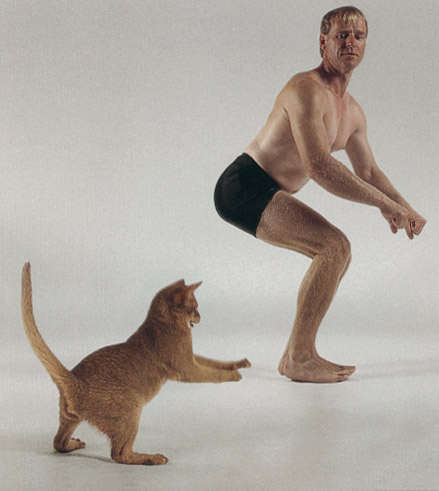
Excerpt from "Dancing With Cats"
Questions Raised:
Does art exist without humans?
Are people products of craft?
Fakes and Forgeries
When looking at the essays done by Alfred Lessing and Denis Dutton about forgery in artwork, there was some confusion as to what exactly constitutes as a forgery, and whether or not there is anything wrong with a forgery in the first place. The book uses the main example of the famous forgery of Van Meegren who passed off his 'Disciples at Emmaus' as a genuine Vermeer, just to later admit to producing them himself. Both authors agree that aesthetically, there isn't much wrong with forgeries, it is rather a fact about the given art, an extra detail. The main conclusion that is drawn is that forgeries lack heavily in originality, and therefore posess technique but perhaps not creativity.
During our class discussion we touched on the point that forgeries sometimes even copy the techniques that were originated by the artist yet I have to say that I do see some originality in Vermeer's Disciples. I think that every artists work, no matter what form, takes bits and pieces from a variety of other artists and themes as a means to develope their own skills and ideas just as anyone does. In this, I think that originality can be found even in forgeries. For example, the famous "Nighthawks" painting by Edward Hopper:

Original 'Nighthawks" by Edward Hopper
Hopper is a renowned painter and 'Nighthawks' is possibly one of his most famous works (and one of my personal favorites). This painting is also widely used by other artists for creating parodies and references. Some of these parodies are obvious and made as jokes, and others are extremely detailed and use similar colors and styles as Hopper:

Lego parody example

Parody example by Banksy

reference from The Simpsons.
Would you consider any of these reproductions to be forgeries of the original? I think that it can take just as much creativity to work off of an existing work as it did to create one, so much so that I actually collect various parody prints of Hoppers "Nighthawks".
Questions raised:
A forgery can posess technique, originality (to a point), and aesthetic qualities, what is it that we value about art which makes originality important for evaluative purposes?
Furthermore...When discussing music, sticking as close to the original work as possible is key to an "authentic" performance, where as with more "physical" art (painting, sculpture, etc.) this can be considered a forgery. Does this mean that authentic performances could be forgeries?
During our class discussion we touched on the point that forgeries sometimes even copy the techniques that were originated by the artist yet I have to say that I do see some originality in Vermeer's Disciples. I think that every artists work, no matter what form, takes bits and pieces from a variety of other artists and themes as a means to develope their own skills and ideas just as anyone does. In this, I think that originality can be found even in forgeries. For example, the famous "Nighthawks" painting by Edward Hopper:

Original 'Nighthawks" by Edward Hopper
Hopper is a renowned painter and 'Nighthawks' is possibly one of his most famous works (and one of my personal favorites). This painting is also widely used by other artists for creating parodies and references. Some of these parodies are obvious and made as jokes, and others are extremely detailed and use similar colors and styles as Hopper:

Lego parody example

Parody example by Banksy
reference from The Simpsons.
Would you consider any of these reproductions to be forgeries of the original? I think that it can take just as much creativity to work off of an existing work as it did to create one, so much so that I actually collect various parody prints of Hoppers "Nighthawks".
Questions raised:
A forgery can posess technique, originality (to a point), and aesthetic qualities, what is it that we value about art which makes originality important for evaluative purposes?
Furthermore...When discussing music, sticking as close to the original work as possible is key to an "authentic" performance, where as with more "physical" art (painting, sculpture, etc.) this can be considered a forgery. Does this mean that authentic performances could be forgeries?
Tuesday, September 29, 2009
Response to Jacob:
I often feel the need to reiterate the distinction between art and beauty. I feel that we often get caught up in the moment and are too eager to ascribe the status of art to anything we find beautiful. Can not something be beautiful without being art? Or am I not right to make this distinction?
I agree with you in making this distinction for a few reasons. Elizabeth Telfer touches on this subject when talking about works of art in a classifying sense in comparison to an evaluative sense; "One problem is that the phrase 'work of art' can be used in either a classifying or an evaluative way...[a classifying sense] is to say something about how the object is regarded, whereas [an evaluative sense] is to say something about the extent to which it merits the label 'work of art' (pg. 14)." Many people tend to see things that they consider to be beautiful and say "ahh that is a work of art" as a means of trying to convey how aesthetically pleasing it is. My bones tell me that technically there is no such thing as unintended art, such as with art found in nature. I believe that nature is beautiful but realistically nature is created with biological means for practicality and use.
In addition to this, I believe that to insinuate that beauty and art are interchangeable is to say that all art is beautiful, which doesn't sit right with me. Not all art is beautiful, some art is created out of painful, frightening, or depressing emotions that the artist feels and is not meant to look beautiful to the audience. It still holds aesthetic value because this kind of art is entirely capable of "moving" the observer. To use the two terms interchangeably in my opinion does not encompass the meaning or do justice to either term.
Musicians often borrow riffs and melodies from the music of their fellow musicians and change them around to create sounds and music for their own. Musicians often are heavily influenced by the melodies and sounds already created by those before them. At what point does an "inauthentic"performance lose so much authenticity that it actually becomes valued as a separate work of art?

I agree with you in making this distinction for a few reasons. Elizabeth Telfer touches on this subject when talking about works of art in a classifying sense in comparison to an evaluative sense; "One problem is that the phrase 'work of art' can be used in either a classifying or an evaluative way...[a classifying sense] is to say something about how the object is regarded, whereas [an evaluative sense] is to say something about the extent to which it merits the label 'work of art' (pg. 14)." Many people tend to see things that they consider to be beautiful and say "ahh that is a work of art" as a means of trying to convey how aesthetically pleasing it is. My bones tell me that technically there is no such thing as unintended art, such as with art found in nature. I believe that nature is beautiful but realistically nature is created with biological means for practicality and use.
In addition to this, I believe that to insinuate that beauty and art are interchangeable is to say that all art is beautiful, which doesn't sit right with me. Not all art is beautiful, some art is created out of painful, frightening, or depressing emotions that the artist feels and is not meant to look beautiful to the audience. It still holds aesthetic value because this kind of art is entirely capable of "moving" the observer. To use the two terms interchangeably in my opinion does not encompass the meaning or do justice to either term.
Musicians often borrow riffs and melodies from the music of their fellow musicians and change them around to create sounds and music for their own. Musicians often are heavily influenced by the melodies and sounds already created by those before them. At what point does an "inauthentic"performance lose so much authenticity that it actually becomes valued as a separate work of art?
Authenticity vs. Success
Stephen Davies overall argument about the authenticity of musical performances focuses on sound, and following the assumed intentions of the composer. He makes it clear that this is an important aspect when evaluating the authenticity of a performance when saying "...musical authenticity aims at the creation of a particular sound and not at the production of a particular visual, social, or other effect." (pg. 61) In the bigger scope of things, I don't necessarily agree with this point because I don't think you can gauge authenticity based on the sound produced alone.
James Young takes a slightly different standpoint, arguing that authenticity is heavily based off of audience perceptions and reactions to a performance. Young almost states what I would consider to be common sense that an authentic performance can be judged by its success. However he does state that success can be considered more important than authenticity in a performance because authenticity just doesn't seem like a consistent source to evaluate music. I agree that degrees of authenticity doesn't seem like a reliable way of judging music but I am still left with a question;
If the success of a performance is judged by the subjective perceptions of the audience, could I then asses that this means a piece could be classified as 'art' for one person, and not be classified as 'art' for another?
James Young takes a slightly different standpoint, arguing that authenticity is heavily based off of audience perceptions and reactions to a performance. Young almost states what I would consider to be common sense that an authentic performance can be judged by its success. However he does state that success can be considered more important than authenticity in a performance because authenticity just doesn't seem like a consistent source to evaluate music. I agree that degrees of authenticity doesn't seem like a reliable way of judging music but I am still left with a question;
If the success of a performance is judged by the subjective perceptions of the audience, could I then asses that this means a piece could be classified as 'art' for one person, and not be classified as 'art' for another?
Tuesday, September 22, 2009
Response to Betsy's Question:
2a.In other words, should a poorly executed painting of a meaningless object be classified under the category of a "major" work of art simply because it is falls under the "major" art forms category, while a sublimely prepared and artistically-presented sumptuous culinary masterpiece is held to evaluations as a "minor" art because "some" have classified it in the "minor" arts category.
I have often asked myself similar questions when browsing contemporary art museums. I feel that in both Telfer and Korsmeyer's explanations there is no clear statement about what makes a "major" art more important and socially acceptable than "minor" art. Telfer uses an example of a pile of metal pipes lying in the corner of a museum, and the observer may wonder if the pile is meant to be an exhibit, or if it was left there for some other reason. My question to this is, if you have to wonder whether or not a pile of pipes in a museum is meant to be an exhibit or not, then does the answer really matter? Is there aesthetic value placed on art congruent to the celebrity status of the artist? I would like to think that a famous Monet is admired widely because of the great artistic abilities that Monet was capable of which produced beautiful work, not siply because it was done by Monet. I have a difficult time grasping Telfer's conclusion because I would think that the art of food, being one that involves a variety of different sensations and combinations in order to experience it as art, could be considered "minor". I would go as far as to call the art of food an applied art, in which it also serves functional purposes as well. However I would not consider it to be unable to provide meaning or importance to those who experience it artistically.
Questions raised:
1. Is there aesthetic value placed on art congruent to the celebrity status of the artist?
I have often asked myself similar questions when browsing contemporary art museums. I feel that in both Telfer and Korsmeyer's explanations there is no clear statement about what makes a "major" art more important and socially acceptable than "minor" art. Telfer uses an example of a pile of metal pipes lying in the corner of a museum, and the observer may wonder if the pile is meant to be an exhibit, or if it was left there for some other reason. My question to this is, if you have to wonder whether or not a pile of pipes in a museum is meant to be an exhibit or not, then does the answer really matter? Is there aesthetic value placed on art congruent to the celebrity status of the artist? I would like to think that a famous Monet is admired widely because of the great artistic abilities that Monet was capable of which produced beautiful work, not siply because it was done by Monet. I have a difficult time grasping Telfer's conclusion because I would think that the art of food, being one that involves a variety of different sensations and combinations in order to experience it as art, could be considered "minor". I would go as far as to call the art of food an applied art, in which it also serves functional purposes as well. However I would not consider it to be unable to provide meaning or importance to those who experience it artistically.
Questions raised:
1. Is there aesthetic value placed on art congruent to the celebrity status of the artist?
Subscribe to:
Posts (Atom)
